
QuickBooks Desktop makes it easy for multiple users to work on the same company file, but a network problem can interrupt multi-user access. When the workstation cannot connect properly to the host computer, QuickBooks Error H202 may appear.
In my experience, the company file is not always the problem. QuickBooks may open normally on the server while a workstation fails to connect. In such cases, the issue is often related to hosting settings, firewall restrictions, QuickBooks Database Server Manager, Windows services, or network connectivity. QuickBooks H202 is part of the same H-series as QuickBooks H505 Error, QuickBooks H101 Error, and QuickBooks H303 Error. These errors can occur when QuickBooks cannot communicate properly with the host server.
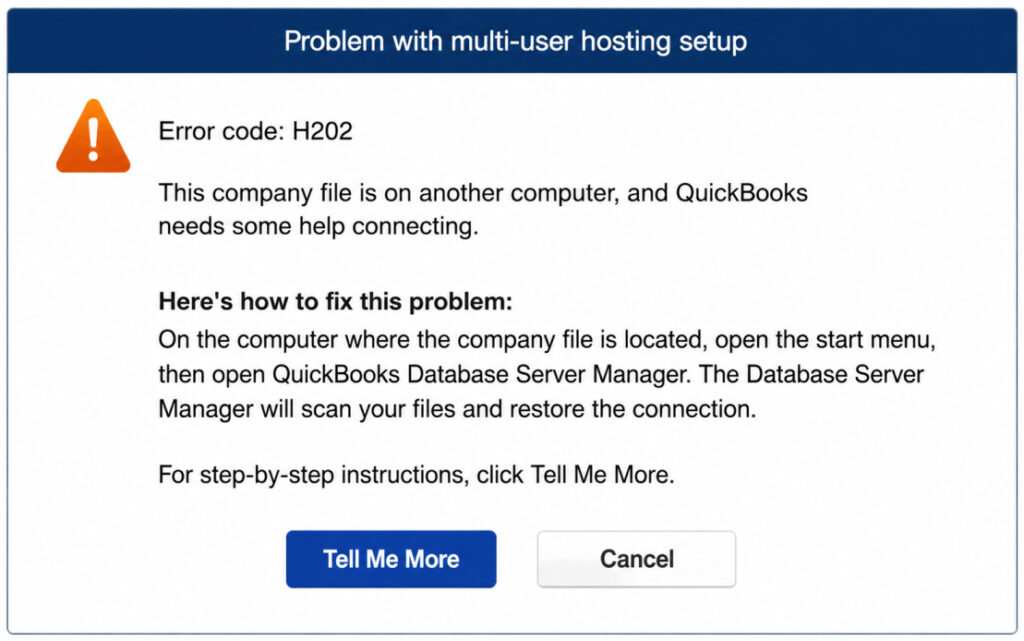
In this guide, we’ve covered the main causes of QuickBooks Error H202, its common symptoms, and the most effective ways to troubleshoot it. Work through the solutions one at a time, starting with the basic network and hosting checks before moving to advanced fixes. If the error continues or you’d prefer professional assistance, you can contact QuickBooks Support Professionals at 1-888-820-7278 for help getting your QuickBooks multi-user setup working properly again.
How Can You Identify QuickBooks Desktop Error H202?
You may be dealing with QuickBooks Error H202 if you notice these signs:
- QuickBooks cannot connect to the computer hosting the company file.
- An H202 message appears when you try to switch to multi-user mode.
- You cannot open the company file from another computer on the network.
- QuickBooks may freeze, respond slowly, or stop during the connection process.
- The error usually appears when you access a company file stored on a different computer.
What Are H-Series Errors in QuickBooks?
H-Series errors in QuickBooks are usually related to multi-user mode, network connectivity, and company file hosting. They occur when QuickBooks cannot communicate properly with the computer or server where the company file is stored.
Common H-Series errors include:
- QuickBooks Error H101
- QuickBooks Error H202
- QuickBooks Error H303
- QuickBooks Error H505
These errors can prevent you from opening a company file in multi-user mode. The cause may be incorrect hosting settings, firewall restrictions, network problems, or issues with QuickBooks Database Server Manager.
How Are QuickBooks H202 and H505 Errors Different?
Although QuickBooks Error H202 and QuickBooks H505 Error belong to the same H-series of multi-user connection errors, they should not be treated as completely separate problems. Both can occur when QuickBooks cannot establish the required connection between a workstation and the computer hosting the company file. Intuit also groups H101 and H303 with these errors.
| Difference | QuickBooks H202 | QuickBooks H505 |
| Main Issue | The workstation cannot properly communicate with the computer hosting the company file. | QuickBooks detects a problem with the multi-user hosting configuration. |
| Common Trigger | Network connection, firewall, or QuickBooks services may prevent the workstation from reaching the host. | A workstation or server may have incorrect hosting settings. |
| First Check | Check the server connection, Database Server Manager, firewall, and QuickBooks services. | Check hosting settings and make sure only the correct server is hosting the company file. |
| Company File | The file may open normally on the server but fail from a workstation. | The file may also be accessible locally while multi-user access fails. |
| Best Approach | Focus first on workstation-to-server communication. | Focus first on hosting configuration, then check network communication. |
In short: H202 usually points you toward a connection problem between the workstation and host, while H505 makes incorrect hosting configuration an important area to investigate. Both errors can still share causes such as firewall restrictions, QuickBooks services, and Database Server Manager issues.
What Are the Possible Causes of QuickBooks Error H202?
QuickBooks Error H202 usually occurs when QuickBooks cannot communicate properly with the server that hosts the company file. The problem can come from network settings, hosting configuration, security software, or QuickBooks services.
Here are the most common causes:
- Incorrect Hosting Settings: The server or workstation may not be configured correctly for multi-user hosting.
- Company File Access Restrictions: QuickBooks may be unable to access the company file because of incorrect folder or network settings.
- Damaged .ND File: A damaged or incorrect Network Data file can prevent QuickBooks from connecting to the server.
- Server IP or Name Problems: QuickBooks may be unable to locate the host computer because of incorrect server details or network configuration.
- Poor Server Communication: The workstation may not be able to communicate properly with the computer where the company file is stored.
- DNS Configuration Issues: Incorrect or incomplete DNS settings can interfere with communication between the workstation and server.
- QuickBooks Services Not Running: Services such as QuickBooksDBXX or QBCFMonitorService may be stopped on the server.
- Firewall or Security Restrictions: Windows Firewall, antivirus, or other security software may block QuickBooks from communicating over the network.
- Multi-User Connection Problems: The workstation may fail to reach the server when trying to open a company file in multi-user mode.
Finding the exact cause is important because H202 is usually a connectivity or hosting problem rather than a sign that the company file itself is damaged.
What Should You Check Before Fixing QuickBooks Error H202?
Before you start troubleshooting QuickBooks Error H202, take a few minutes to check the basics. This can prevent unnecessary changes and make the troubleshooting process easier.
- Make sure you have administrator access to Windows and QuickBooks.
- Update QuickBooks Desktop to the latest available release.
- Confirm that the server and workstations are connected to the same network.
- Check that the company file is stored on the designated host computer.
- Make sure QuickBooksDBXX and QBCFMonitorService are running on the server.
- Check that the Windows firewall allows QuickBooks to communicate across the network.
- Keep a recent backup of your company file before making major changes.
Once these checks are complete, you can move on to the actual H202 troubleshooting steps.
Effective Solutions to Resolve QuickBooks H202 Error
This method is designed to pinpoint network issues that can interfere with QuickBooks’ connection. It checks for common problems such as slow network responses and packet loss, giving you a clearer picture of what’s causing the H202 error. Follow the steps below to troubleshoot the network and restore a stable QuickBooks connection.
Method 1: Use QuickBooks Tool Hub to Fix Error H202
The QuickBooks Tool Hub is one of the easiest ways to troubleshoot common QuickBooks Desktop problems. Its Network Issues and Company File Issues tools can help identify problems with the company file, network configuration, and QuickBooks services.
Step 1: Install QuickBooks Tool Hub
- Close QuickBooks Desktop on all computers.
- Download and install the latest version of QuickBooks Tool Hub from Intuit.
- Run the QuickBooksToolHub.exe installation file.
- Follow the on-screen instructions to complete the installation.
- Open QuickBooks Tool Hub from the desktop or Windows Start menu.
Step 2: Run QuickBooks Database Server Manager
On the computer where the company file is stored:
- Open QuickBooks Tool Hub.
- Select Network Issues.
- Choose QuickBooks Database Server Manager.
- If prompted, install or update the Database Server Manager.
- Select the folder containing your QuickBooks company file.
- If the folder isn’t listed, click Browse and locate it manually.
- Click Start Scan.
The Database Server Manager scans the folder and helps configure the network settings required for QuickBooks multi-user access. Once the scan finishes, open QuickBooks on a workstation and try: File → Switch to Multi-User Mode If the company file opens successfully, Error H202 should be resolved.
Step 3: Run QuickBooks File Doctor
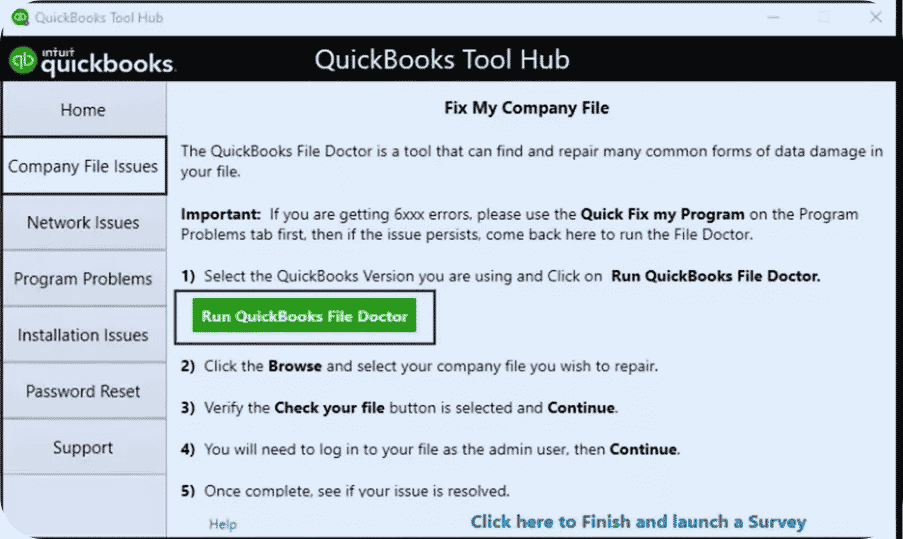
If H202 continues to appear, run File Doctor:
- Open QuickBooks Tool Hub.
- Select Company File Issues.
- Click Run QuickBooks File Doctor.
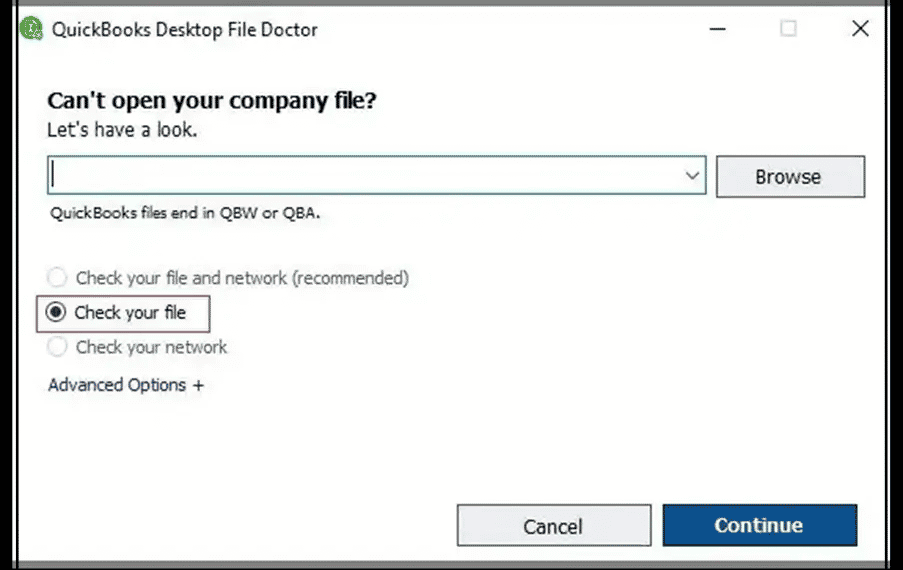
- Select your company file or browse to find it.
- Choose Check your file and network.
- Click Continue.
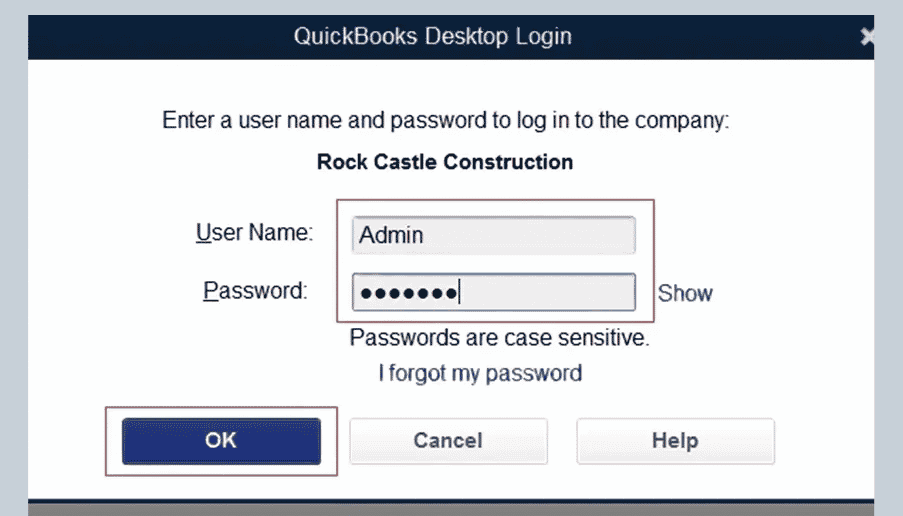
- Enter your QuickBooks administrator password when prompted.
- Click OK and allow the scan to finish.
After the repair is complete, try opening the company file again in Multi-User Mode. If H202 is still there, move on to the next method.
Method 2: Check QuickBooks Hosting Settings and Services
QuickBooks Error H202 can occur when the computer storing the company file is not properly configured to host it. Only the server computer should host the company file in a typical QuickBooks multi-user setup.
Step 1: Check Hosting Settings
- Open QuickBooks Desktop.
- Go to File → Utilities.
- Look for Host Multi-User Access.
- If you see Host Multi-User Access, select it to enable hosting.
- If you see Stop Hosting Multi-User Access, hosting is already enabled.
On workstations, you should normally see Host Multi-User Access, which means hosting is not enabled on those computers. Avoid enabling hosting on multiple computers because it can create conflicts and contribute to connection problems.
Step 2: Make Sure QuickBooks Services Are Running
QuickBooks relies on Windows services to manage company-file access over the network.
- Press Windows + R.
- Type services.msc.
- Press Enter.
- Find the QuickBooksDBXX service. The XX varies depending on your QuickBooks Desktop version.
- Find QBCFMonitorService as well.
For each service:
- Right-click the service and select Properties.
- Set Startup type to Automatic.
- If the service is stopped, click Start.
- Open the Recovery tab.
- Set the first, second, and subsequent failures to Restart the Service.
- Click Apply, then OK.
Step 3: Test Multi-User Mode
Open QuickBooks on a workstation and select: File → Switch to Multi-User Mode. If the company file opens normally, the problem was likely related to hosting or a stopped QuickBooks service. If H202 remains, continue to the next method.
Method 3: Check Windows Folder Permissions
Incorrect Windows permissions can prevent QuickBooks from accessing or sharing the company file correctly.
Step 1: Check Company File Permissions
On the server:
- Open File Explorer.
- Find the folder containing your QuickBooks company file.
- Right-click the folder and select Properties.
- Open the Security tab.
- Select Advanced.
- Locate the appropriate QBDataServiceUserXX account for your QuickBooks version.
- Check its permissions.
The account may need permissions such as:
- Traverse Folder / Execute File
- List Folder / Read Data
- Read Attributes
- Read Extended Attributes
- Create Files / Write Data
- Create Folders / Append Data
- Write Attributes
- Write Extended Attributes
- Read Permissions
If the required permissions are missing, adjust them according to your Windows and QuickBooks configuration.
Important: Avoid giving unnecessary Full Control permissions to broad user groups. If you need to change permissions, apply them to the appropriate QuickBooks service account and company-file folder.
Step 2: Check Related QuickBooks Folders
You may also need to check permissions for QuickBooks and Intuit folders, including locations such as:
- C:\ProgramData\Intuit\Entitlement Client\
- C:\ProgramData\Intuit\QuickBooks XX\
- C:\ProgramData\Common Files\Intuit\
- C:\Users\Public\Public Documents\Intuit\QuickBooks\Company Files\
The exact folders can vary depending on your QuickBooks version and installation.
Step 3: Check Folder Sharing
Next, verify that the company-file folder is properly shared:
- Right-click the company-file folder.
- Select Properties.
- Open the Sharing tab.
- Select Advanced Sharing or the appropriate Windows sharing option.
- Confirm that the folder is shared across your network.
- Review the share permissions and make sure the appropriate QuickBooks service account and users have the access they require.
Step 4: Restart QuickBooks Services
After changing permissions:
- Open services.msc.
- Restart QuickBooksDBXX.
- Restart QBCFMonitorService.
Then open QuickBooks on a workstation and test Multi-User Mode again.
Method 4: Configure Windows Firewall and Security Software
A firewall can block the network traffic QuickBooks needs to communicate between workstations and the server. When this happens, QuickBooks may display Error H202 even though the company file itself is healthy.
Step 1: Run QuickBooks File Doctor First
Before creating firewall rules manually:
- Open QuickBooks Tool Hub on the server.
- Select Company File Issues.
- Run QuickBooks File Doctor.
- Select Check your file and network.
- Allow the tool to complete its scan.
If the error continues, check the firewall manually.
Step 2: Allow QuickBooks Through Windows Firewall
Open Windows Defender Firewall with Advanced Security and review the inbound and outbound rules. QuickBooks uses different ports depending on the Desktop version. Some versions also use a dynamic port assigned by the QuickBooks Database Server Manager. For this reason, do not rely on a generic port list alone. Check the Port Monitor or Database Server Manager for the ports assigned to your specific QuickBooks installation. Create the required TCP inbound and outbound rules for the ports used by your version of QuickBooks.
- Open Windows Defender Firewall with Advanced Security.
- Select Inbound Rules.
- Click New Rule.
- Select Port.
- Choose TCP.
- Enter the required QuickBooks ports.
- Select Allow the connection.
- Apply the rule to the appropriate network profiles.
- Give the rule a recognizable name, such as QuickBooks Inbound Ports.
- Repeat the process under Outbound Rules.
Step 3: Allow QuickBooks Program Files
You can also create firewall exceptions for the QuickBooks applications and services used by your installation.
Common executable files may include:
- QBW32.exe
- QBDBMgrN.exe
- QBCFMonitorService.exe
- QBServerUtilityMgr.exe
- FileManagement.exe
- Dbmlsync.exe
- AutoBackupExe.exe
- IntuitSyncManager.exe when applicable
The location of these files depends on your QuickBooks version and installation path. A common location is:
C:\Program Files\Intuit\QuickBooks [Year]\
Only allow files that are actually installed with your QuickBooks version.
Step 4: Check Third-Party Security Software
If you use antivirus software or a third-party firewall, check its network protection settings as well.
Make sure the software isn’t blocking:
- QuickBooks ports
- QuickBooks executable files
- QuickBooks Database Server Manager
- QuickBooks network services
If QuickBooks works only after temporarily disabling your security software, the software is likely interfering with the connection. Re-enable protection and configure an appropriate exception rather than leaving the firewall or antivirus disabled.
Step 5: Test QuickBooks Again
Restart the server and, if necessary, the workstations. Then open QuickBooks on a workstation and select: File → Switch to Multi-User Mode. If the firewall was blocking QuickBooks, H202 should now be resolved.
Method 5: Test the Network Connection Between the Workstation and Server
If QuickBooks cannot communicate reliably with the server, Error H202 can appear.
A simple ping test can help determine whether the workstation can reach the server.
Step 1: Turn On Network Discovery
On the server and workstations:
- Open Control Panel.
- Go to the Network and Sharing Center.
- Select Change advanced sharing settings.
- Turn on Network Discovery.
- Turn on File and Printer Sharing.
- Save the changes.
Step 2: Find the Server Name
On the server:
- Open Command Prompt.
- Type: Ip config /all
- Press Enter.
- Note the computer’s Host Name and IPv4 address.
For example:
- Host Name: QBServer
- IPv4 Address: 192.168.1.50
Step 3: Ping the Server
On the workstation experiencing H202:
- Open Command Prompt.
- Type: ping QBServer
Replace QBServer with your actual server name.
- Press Enter.
Step 4: Check the Results
If you receive replies with little or no packet loss, the workstation can communicate with the server.
If you see a request timed out or significant packet loss, investigate the network connection.
Possible causes include:
- Computers connected to different networks
- Different VLANs or subnets
- Firewall restrictions
- Router configuration
- Wi-Fi problems
- Network cable problems
- Server connectivity issues
Repeat the test on each workstation that needs access to the company file.
If every workstation can ping the server but QuickBooks still displays H202, the next step is to investigate name resolution.
Method 6: Check Windows Name Resolution With the Hosts File
Sometimes a workstation can reach the server but cannot correctly resolve its computer name. In this situation, manually adding the server to the Windows hosts file can help with troubleshooting.
Step 1: Get the Server IP Address and Name
On the server, open Command Prompt and run:
ipconfig /all
Write down:
- The server’s Host Name
- The server’s IPv4 address
For example:
QBServer
192.168.1.50
Step 2: Open the Hosts File
On the affected workstation:
- Sign in with an administrator account.
- Open Notepad as an administrator.
- In Notepad, open:
C:\Windows\System32\Drivers\etc\hosts
The hosts file has no file extension.
Step 3: Add the Server Information
At the bottom of the hosts file, add the server’s IP address followed by its computer name:
192.168.1.50 QBServer
Use the actual IP address and server name from your network.
Step 4: Save the File
Save the hosts file and close Notepad.
If Windows doesn’t allow you to save the file, make sure Notepad was opened with Run as administrator.
Step 5: Repeat on Other Workstations
If multiple workstations have the same name-resolution problem, you may need to add the server entry to each affected computer.
Then test QuickBooks Multi-User Mode again.
Note: Editing the hosts file is an advanced troubleshooting step. If your network uses DHCP and the server’s IP address changes, a manually entered IP address can become outdated. A stable server address or properly configured DNS is usually a better long-term solution.
Method 7: Try Additional QuickBooks Troubleshooting Steps
If you’ve worked through the previous methods and Error H202 still appears, try these additional solutions.
A. Recreate the QuickBooks Network Data (.ND) File
The .ND file helps QuickBooks identify and connect to the company file over the network.
On the server:
- Open the folder containing the company file.
- Find the .ND file associated with your company file.
For example:
MyCompanyFile.qbw.nd
- Close QuickBooks.
- Rename the .ND file, such as:
MyCompanyFile.qbw.nd.old
- Reopen QuickBooks.
- Open the company file.
- Use the Database Server Manager or appropriate QuickBooks network setup to recreate the network configuration.
Then test Multi-User Mode from a workstation.
B. Move the Company File to a New Folder
If the existing company-file folder has complicated permissions or sharing problems, creating a clean shared folder can help determine whether the folder configuration is the issue.
For example, create: C:\QBFiles\Shared
Then:
- Configure the folder with the appropriate Windows sharing and security permissions.
- Copy the company file into the new location.
- Use QuickBooks to open the company file from the new folder.
- Configure the new folder with QuickBooks Database Server Manager.
- Test Multi-User Mode again.
Avoid moving or deleting the original company file until you have confirmed that the new setup works correctly.
How Can You Fix QuickBooks Errors H101, H303, and H505?
QuickBooks H101, H303, and H505 are commonly associated with incorrect hosting or communication settings in a multi-user environment. The following steps help identify and correct the most common configuration problems.
Step 1: Check Which Computer Is Hosting the Company File
First, identify the computer where the company file is stored and intended to be hosted.
- Open QuickBooks Desktop on the server.
- Go to File > Utilities.
- If Host Multi-User Access appears, select it.
- If Stop Hosting Multi-User Access appears, hosting is already enabled.
The server should be the designated host for the company file.
Step 2: Turn Off Hosting on Workstations
Incorrect hosting on a workstation can interfere with multi-user access.
- Open QuickBooks Desktop without opening the company file.
- Go to File > Utilities.
- If Stop Hosting Multi-User Access appears, select it.
- Repeat these steps on other workstations.
This helps ensure that workstations are connecting to the server instead of attempting to host the company file themselves.
Step 3: Verify QuickBooks Database Server Manager
QuickBooks Database Server Manager should be installed and configured on the computer hosting the company files.
- Open QuickBooks Tool Hub.
- Select Network Issues.
- Open QuickBooks Database Server Manager.
- Select or browse to the folder containing the company file.
- Click Start Scan.
- Wait for the scan to complete.
After scanning, test the company file again from a workstation.
Step 4: Check QuickBooks Services
On the server, open Windows Services by entering services.msc.
Check these services:
- QuickBooksDBXX
- QBCFMonitorService
Make sure they are running and configured to start automatically. If either service is stopped, start it and then test multi-user mode again.
Step 5: Check Firewall and Network Connectivity
A firewall can prevent workstations from communicating with the QuickBooks server.
- QuickBooks applications are allowed through the firewall.
- Required QuickBooks ports are permitted.
- The workstation and server are connected to the appropriate network.
- The workstation can communicate with the server.
If necessary, test the server connection with ping from the affected workstation.
Step 6: Test Multi-User Mode Again
After correcting the hosting and network settings:
- Open QuickBooks Desktop on the server.
- Confirm the company file opens normally.
- Open QuickBooks on a workstation.
- Select File > Switch to Multi-User Mode.
- Try opening the company file.
If the file opens successfully, the H101, H303, or H505 error should no longer appear.
Tips to Prevent QuickBooks H202 Error
Once you’ve fixed QuickBooks Error H202, a few simple maintenance steps can help prevent it from returning:
- Keep hosting configured correctly: Make sure the correct server is set up to host the company file and workstations are configured properly for multi-user access.
- Monitor QuickBooks services: Ensure QBCFMonitorService and the appropriate QuickBooksDBXX service are running on the server.
- Maintain a stable network: Avoid unnecessary changes to DNS, IP, firewall, or other network settings that could interrupt communication.
- Keep QuickBooks updated: Install available QuickBooks Desktop updates to maintain compatibility and stability.
- Check firewall settings: Make sure your firewall continues to allow QuickBooks and its required network services to communicate.
- Use regular backups: Keep recent company-file backups so you can recover your accounting data if a serious network or file issue occurs.
When Should You Seek Professional Help for QuickBooks Error H202?
If QuickBooks Error H202 continues after you’ve checked the hosting settings, network connection, firewall, and QuickBooks services, it may be time to get professional assistance. Some H202 problems involve deeper server, Windows, or network configuration issues that can be difficult to identify without technical experience.
If you’re not comfortable changing advanced settings, it’s safer to get help rather than risk affecting your QuickBooks environment. You can reach the support team at Sage Accounting Support or call 1-888-820-7278 for assistance with diagnosing and resolving persistent QuickBooks multi-user errors.
Final Thoughts:
QuickBooks errors H202 and H505 can disrupt daily operations, but they are entirely fixable with the right approach. By correctly configuring hosting settings, running QuickBooks tools, and ensuring your network and firewall allow proper communication, you can restore stable multi-user access.
Frequently Asked Questions
QuickBooks Error H202 appears when a workstation cannot communicate with the computer hosting the company file. Common causes include incorrect hosting settings, firewall or antivirus blocking QuickBooks traffic, QuickBooks Database Server Manager not running, network issues like DNS or server name resolution problems, and blocked ports necessary for QuickBooks communication.
Multi-user mode may fail because:
1. The QuickBooks Database Server Manager service is not running on the server.
2. Firewall or security software is blocking QuickBooks programs or network ports.
3. Hosting settings are incorrect (a workstation is hosting instead of the server).
4. Network connectivity issues prevent workstations from seeing the server.
5. Corrupted .ND network data files interfere with connections.
Error 6175 (often with -6175,0 variant) usually appears when trying to enable Multi-User mode but hosting settings or network configuration are incorrect. Fixes include:
1. Ensure only the server has hosting enabled.
2. On workstations, turn off hosting if it’s mistakenly enabled.
3. On the server, reset hosting by toggling it off and on.
4. Use the QuickBooks File Doctor tool to repair network and company file issues.
5. Check Windows permissions and firewall settings so QuickBooks components can communicate.
The QBDBMgrN service (QuickBooks Database Server Manager) must run on the computer that hosts the company file for multi-user access. If it’s not running, possible causes are:
1. The Windows firewall or antivirus blocking the service or ports.
2. The service failed to start or is disabled in Windows Services.
3. QuickBooks Database Server Manager installation is missing or corrupted.
4. QuickBooks and Database Server Manager versions don’t match.
Fixes often include: restarting the service, updating QuickBooks, adjusting firewall settings, repairing the QuickBooks installation, and ensuring the correct version of Database Server Manager is installed.
To fix Error H202 on Windows 11:
1. Use QuickBooks Tool Hub → Network Issues → run QuickBooks Database Server Manager scan.
2. Run QuickBooks File Doctor to diagnose network issues.
3. Make sure QuickBooks Database Server Manager and related services are running and set to Automatic.
4. Configure Windows Firewall to allow QuickBooks executables and necessary ports.
5. Verify hosting settings — server must host, workstations must not.
6. Confirm network connectivity (e.g., ping the server from workstations).
Errors 6190 and 816 happen when a company file is being accessed in single-user mode while another user tries to open it in multi-user mode. Solutions include:
1. Ensure all users are in multi-user mode before opening the file.
2. Update QuickBooks to the latest version.
3. Rename the .ND and .TLG files for the company file so QuickBooks recreates fresh network and log data.
4. Use QuickBooks Database Server Manager scan through Tool Hub to repair network settings.
Yes. QuickBooks Error H202 can occur in both Pro and Premier editions when the workstation cannot communicate properly with the computer hosting the company file. The troubleshooting steps may vary depending on your QuickBooks Desktop version and network setup.
Yes. QuickBooks Enterprise can also encounter H202 when multi-user communication between the workstations and server is interrupted. Because Enterprise environments often have more users and a dedicated server, hosting and network configuration should be checked carefully.
Yes. QuickBooks Desktop 2024 can experience H202 when there is a problem with multi-user connectivity. Make sure the corresponding QuickBooks Database Server Manager and services are properly installed and configured for the 2024 environment.
Yes. Renewing or changing a QuickBooks Desktop subscription does not itself eliminate network-related H202 problems. If the error appears after a subscription change or software update, check whether the QuickBooks installation, Database Server Manager, and hosting environment are still configured for the installed version.
Usually, no. QuickBooks Payroll and H202 address different areas of QuickBooks. H202 is primarily associated with multi-user communication and hosting. However, if payroll users cannot access the company file because of H202, payroll-related work can also be interrupted.